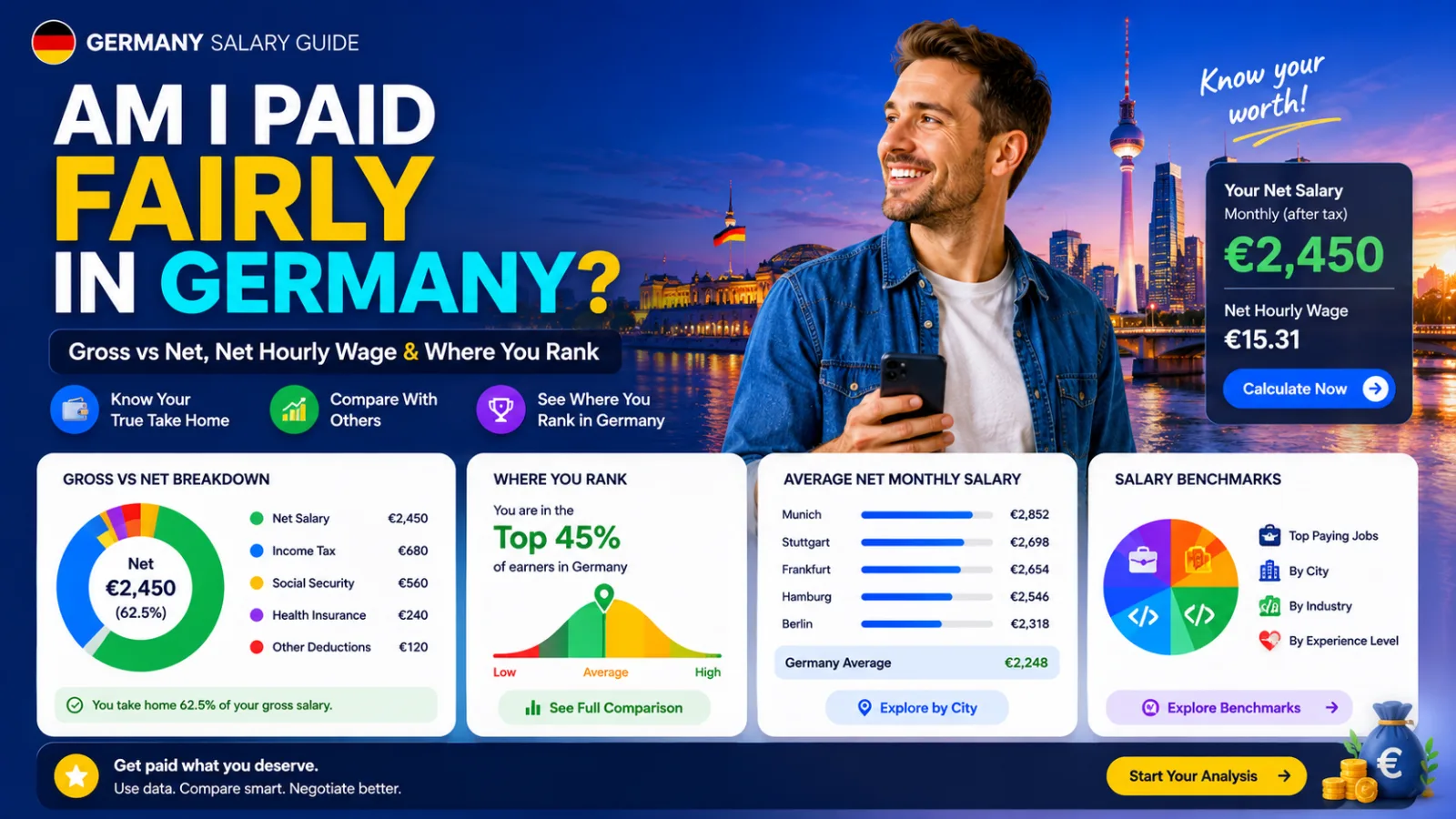
- German full-time gross median is about €53,700/year (~€4,480/month) as of 2024/25, half earn less, half earn more.
- On a mid salary, income tax plus ~20% employee social contributions take roughly 35-45% of gross; €45,000 gross nets about €2,436/month.
- Net hourly wage (net pay divided by real hours worked) is the fair way to compare offers, a lower-gross job can pay more per hour.
- Benefits like bAV, a €50 Sachbezug and Jobticket beat gross raises euro-for-euro, and the Entgelttransparenzgesetz lets staff in firms over 200 ask colleagues' median pay.
Quick answer: To judge whether you are paid fairly in Germany, compare your gross salary to the full-time median of roughly €53,700/year (about €4,480/month) as of 2024/25 (approximate), then look at what actually lands in your account. On a mid salary, income tax plus your share of social contributions eats roughly 35-45% of gross, so a €4,480 gross month is often €2,800-€3,000 net. "Fair" is not one number: it depends on your role, region, sector, hours and experience. The most honest comparison between two jobs is your net hourly wage, net pay divided by hours actually worked, not the headline gross figure.
Why your net is so much smaller than your gross
The gap between gross (brutto) and net (netto) surprises almost everyone who moves to Germany or starts their first job here. It is not one deduction but a stack of them. First comes income tax (Lohnsteuer), which is progressive: the first €12,348 of taxable income in 2026 (the Grundfreibetrag) is tax-free, and the rate then climbs from 14% up to 42%. On top of that sit your employee social contributions, pension, health, long-term care and unemployment insurance, which together take roughly 20% of gross, each capped at its own income ceiling (Beitragsbemessungsgrenze).
Here is a realistic breakdown for a single employee (tax class I, no church tax, statutory health insurance) earning €45,000 gross per year, about €3,750 per month. All figures are estimates for illustration; your exact numbers depend on your health insurer's Zusatzbeitrag, children, and federal state.
| Item | Rate (employee share) | Per year (est.) | Per month (est.) |
|---|---|---|---|
| Gross salary | , | €45,000 | €3,750 |
| Pension insurance (Rentenversicherung) | 9.3% | −€4,185 | −€349 |
| Health insurance (Krankenversicherung, incl. ~1.7% Zusatzbeitrag) | ~8.15% | −€3,668 | −€306 |
| Long-term care (Pflegeversicherung, no children) | ~2.3% | −€1,035 | −€86 |
| Unemployment insurance (Arbeitslosenversicherung) | 1.3% | −€585 | −€49 |
| Total social contributions | ~21% | −€9,473 | −€789 |
| Income tax (Lohnsteuer) | progressive | −€6,300 | −€525 |
| Solidarity surcharge | 0% (below threshold) | €0 | €0 |
| Net salary (est.) | , | ≈€29,227 | ≈€2,436 |
So a €45,000 gross salary leaves roughly €2,436 net per month, a total burden of about 35%. Notice that the two big levers are different in nature: social contributions are broadly flat as a percentage until you hit the ceilings, while income tax rises with every extra euro. That is why a raise from €45,000 to €50,000 does not give you 100% of the difference, the top slice is taxed at your marginal rate, not your average rate.
One widespread misunderstanding is worth clearing up: your Steuerklasse (tax class) does not change how much tax you owe over the year. It only changes how much is withheld each month. A married person in class III sees a fatter monthly net, but the annual liability is settled at the tax return; class V does the reverse. If you switch classes you are moving cash between months, not reducing the total.
What counts as a "good" salary in Germany?
The honest answer is: it depends what you compare against. The full-time median gross is about €53,700/year (roughly €4,480/month) as of 2024/25, meaning half of full-time employees earn less and half earn more. The average (mean) is pulled higher by top earners, so the median is the fairer yardstick for "typical". Here is an approximate picture of where different gross salaries sit among German full-time employees. Treat the percentiles as estimates, they shift by year, region and data source.
| Annual gross (est.) | Monthly gross (est.) | Roughly where you rank |
|---|---|---|
| €32,000 | €2,667 | ~20th percentile, entry-level / lower-wage sectors |
| €42,000 | €3,500 | ~35th percentile, below the median |
| €53,700 | €4,480 | ~50th percentile, the median |
| €65,000 | €5,417 | ~65th-70th percentile, comfortably above average |
| €85,000 | €7,083 | ~85th percentile, top sixth of earners |
| €110,000+ | €9,167+ | ~95th percentile, top earners |
Ranking against the national median is only a starting point. A €55,000 salary is above median nationally but might be unremarkable for a software engineer with five years' experience in Munich, and generous for an administrative role in Saxony. Always narrow the comparison to your role, sector, region and experience before drawing conclusions.
Net hourly wage: the fair way to compare two offers
Headline gross figures hide the single most important variable: how many hours you actually work. A "higher-paying" job with a 45-hour week and an unpaid extra can pay you less per hour than a lower-gross job with a genuine 38-hour week and six weeks of leave. The fix is simple, compute the net hourly wage.
Worked example. Two real-feeling offers for the same person (single, tax class I):
- Offer A: €58,000 gross, contracted 40 hours/week, but the role realistically runs 46 hours. Net ≈ €3,050/month → ≈ €36,600/year.
- Offer B: €52,000 gross, contracted 38 hours/week and genuinely respected, 30 days leave. Net ≈ €2,800/month → ≈ €33,600/year.
Now convert to net per hour actually worked. Assume about 45 working weeks after leave and public holidays.
| Metric | Offer A (€58k) | Offer B (€52k) |
|---|---|---|
| Net per year (est.) | €36,600 | €33,600 |
| Real hours/week | 46 | 38 |
| Working weeks/year | ~45 | ~45 |
| Hours/year | 2,070 | 1,710 |
| Net € per hour (est.) | ≈€17.68 | ≈€19.65 |
The "smaller" offer pays about 11% more per hour of your life. This is the calculation almost nobody does before signing, and it routinely flips which job is genuinely better. When you compare offers, or judge whether your current job is fair, always divide net pay by real hours, then layer in commute time, remote flexibility, and pension contributions on top.
How to actually earn more (and keep more)
Because of progressive taxation, a gross raise is worth less than it looks, you keep only the after-tax slice. Several levers beat a straight gross increase euro for euro:
- Company pension (bAV / Entgeltumwandlung): contributions from gross are free of tax and, up to limits, social contributions, and employers must add at least 15% on top of what they save. It is one of the few ways to convert gross into value at close to 100%.
- Jobticket / Deutschlandticket subsidy: an employer-paid transit ticket can be tax-free, unlike the equivalent cash which would be taxed.
- Sachbezug (benefit in kind): up to €50/month can be given tax- and contribution-free (e.g. a benefits card). That is €600/year net, worth roughly €1,000 of gross raise to match.
- Tax-free inflation-type or child bonuses, meal allowances, and home-office lump sums where offered.
On the negotiation side, use data. The Entgelttransparenzgesetz (Pay Transparency Act) gives employees in companies with more than 200 staff the right to ask, in writing, for the median gross pay of colleagues of the opposite sex doing comparable work (the comparison group must be at least six people). That median is a powerful, legally-grounded anchor when you ask for a raise, you are no longer arguing from feeling but from your employer's own numbers. Combine it with sector salary data and your net-hourly analysis.
A practical sequence: (1) benchmark your role with public salary data and, if eligible, an Entgelttransparenzgesetz request; (2) quantify your contribution in euros or delivered projects; (3) ask for the gross figure and a benefits package; (4) if gross is capped, pivot to bAV, Sachbezug and time (extra leave, a 38-hour week) which often cost the employer less but improve your net hourly wage more.
Regional and sector differences are large
Two people with the same job title can fairly earn very different amounts. Salaries in Bavaria, Baden-Württemberg and Hesse (Munich, Stuttgart, Frankfurt) run well above those in several eastern states, though the gap has narrowed and living costs differ sharply, a higher Munich gross can buy less housing than a lower Leipzig one. By sector, IT, finance, pharma and automotive engineering sit at the top; hospitality, retail and care work sit well below the median. Company size and collective agreements (Tarifvertrag) matter too: a Tarif-bound industrial employer often pays more, with clearer raise steps, than a small non-Tarif firm. When you assess fairness, always compare like with like: same role, same region, same sector, similar company size.
🧮 Check your salary: Our free Gehaltscheck turns your gross into an estimated net, shows your total tax-and-social burden, and reveals your net hourly wage so you can see where you really rank.
Sources
- Statistisches Bundesamt (Destatis), earnings statistics and full-time median/average gross earnings, 2024/25.
- Bundesministerium der Finanzen, Grundfreibetrag and income tax tariff (Einkommensteuertarif), 2026.
- Deutsche Rentenversicherung / GKV-Spitzenverband, social contribution rates and Beitragsbemessungsgrenzen.
- Entgelttransparenzgesetz (EntgTranspG), statutory right to pay information in firms over 200 employees.
- Einkommensteuergesetz (EStG) §3, tax-free benefits (Sachbezug, Jobticket, bAV).
FAQ
Is €50,000 a good salary in Germany?
€50,000 gross is slightly below the full-time median of about €53,700, so it is a solid, roughly typical salary, comfortable in lower-cost regions and average-to-tight in Munich or Frankfurt. As a single person you would keep roughly €2,650 net per month (estimate). Whether it is "fair" depends on your role and experience: for a junior it is good, for a senior engineer it may be low.
Why did my net barely rise after a raise?
Because income tax is progressive: the extra euros are taxed at your marginal rate (up to 42%), not your lower average rate, and if the raise pushes part of your income above a social-contribution ceiling that portion is treated differently too. It is normal to keep only 50-65% of a gross raise. Non-cash benefits like bAV or a €50 Sachbezug can deliver more net value than the same money as taxable gross.
Does changing my tax class give me more money?
No, over the full year it does not change what you owe. Steuerklasse only shifts how much Lohnsteuer is withheld each month. Married couples use classes III/V or IV/IV to move net between the two partners' monthly pay; the total is reconciled in the annual tax return. It affects cash flow, not the final bill.
How do I compare two job offers fairly?
Convert each to net pay, then divide by the hours you will actually work per year (not the contracted figure), to get a net hourly wage. Add pension contributions, leave days, commute and flexibility. A lower-gross job with real 38-hour weeks often beats a higher-gross job that quietly demands 46.
Can I ask what my colleagues earn?
If your employer has more than 200 staff, yes, the Entgelttransparenzgesetz gives you a written right to the median gross pay of colleagues of the opposite sex doing comparable work, provided the comparison group has at least six people. It is one of the strongest, most objective anchors you can bring to a pay negotiation.
Written by Lukas Weber, Steuerberater. Reviewed by Markus Weber. This article is general information, not individual tax or financial advice; figures are estimates for illustration and depend on your personal circumstances, federal state, health insurer and tax year. For a binding assessment consult a Steuerberater.
Comments (0)
Leave a comment
Your email will not be published. Comments are moderated before they appear.