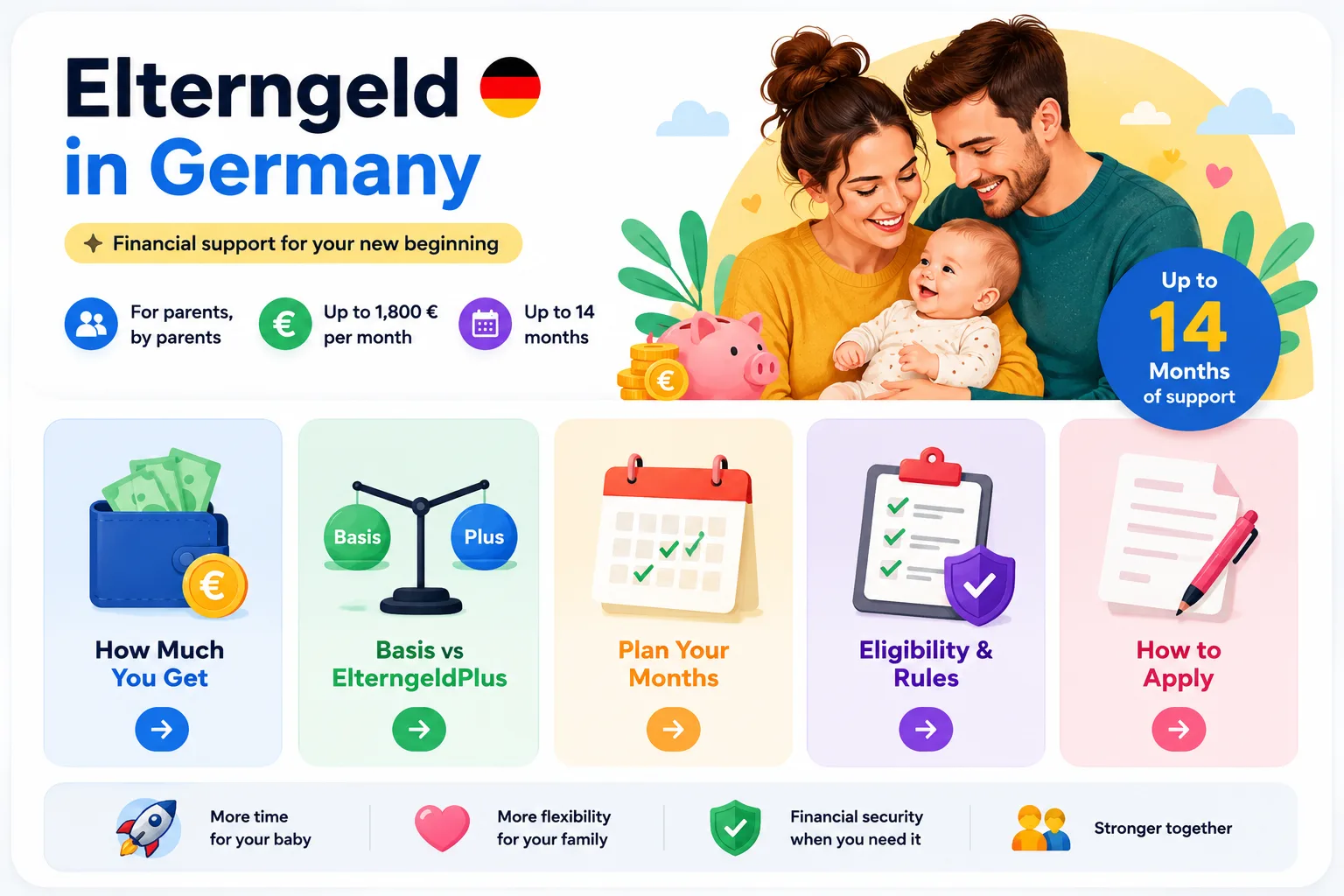
- Basiselterngeld replaces ~65-67% of pre-birth net income, capped between €300 and €1,800 per month.
- One parent gets 12 months; both taking leave unlocks 2 Partnermonate for 14 months total.
- ElterngeldPlus halves the monthly amount but doubles the months, better when working part-time.
- Couples with taxable income above €175,000 get nothing, and the Progressionsvorbehalt can trigger a tax back-payment.
Quick answer: Elterngeld (German parental allowance) replaces roughly 65-67% of your average monthly net income from the 12 months before birth, capped between €300 and €1,800 per month. One parent can draw Basiselterngeld for 12 months; if both take at least some time off, you unlock 2 extra Partnermonate for 14 months total. ElterngeldPlus halves the monthly payment but doubles the number of months, which usually wins if you work part-time during the leave. Couples with joint taxable income above €175,000 get nothing. It is tax-free but counts toward your tax rate via the Progressionsvorbehalt.
What Elterngeld is and who qualifies
Elterngeld is a state benefit that partly replaces the income you lose while caring for a newborn. It is not the same as Kindergeld (the flat monthly child benefit you receive for years) or the tax-side Kinderfreibetrag. Elterngeld is a short-term wage replacement for the first months of your child's life, administered by regional Elterngeldstellen and governed by the Bundeselterngeld- und Elternzeitgesetz (BEEG).
You generally qualify if you:
- live in the same household as your child and care for the child yourself;
- work no more than 32 hours per week on average during the months you claim;
- have your main residence or habitual abode in Germany (or an equivalent EU/EEA situation); and
- do not exceed the income cap (see below).
Employees, self-employed people, students, apprentices and even parents with no pre-birth income all qualify. Someone with zero prior income still receives the €300 minimum, Elterngeld is deliberately inclusive at the bottom. Adoptive parents and, in hardship cases, relatives caring for the child can also claim.
How the amount is calculated: the replacement rate
The core of Elterngeld is a replacement rate applied to your average net income in the 12 calendar months before the month of birth (for the self-employed, the relevant tax year is used instead). The percentage is not flat:
- 67% if your pre-birth net was below roughly €1,000 per month;
- a sliding scale tapering from 67% down to 65% between about €1,000 and €1,200; and
- 65% once your net was above roughly €1,200.
The result is then bounded: never less than €300 and never more than €1,800 per month for Basiselterngeld. Because of the €1,800 ceiling, the replacement rate effectively flattens out for higher earners, above a net of about €2,770 you simply hit the cap. There are also small top-ups: a Geschwisterbonus (typically +10%, at least €75/month) if you have another young child in the household, and a Mehrlingszuschlag of €300 for each additional baby in a multiple birth. All figures here are estimates for orientation; your Elterngeldstelle calculates the binding amount.
Worked example: net €2,000 per month
Imagine a parent, "Anna," whose average net income in the 12 months before birth was €2,000. Because that is above the €1,200 threshold, her replacement rate is 65%.
| Item | Figure (estimate) |
|---|---|
| Average pre-birth net income | €2,000 / month |
| Replacement rate | 65% |
| Basiselterngeld (monthly) | €1,300 / month |
| 12 months, one parent only | €1,300 × 12 = €15,600 |
| 14 months (with 2 Partnermonate) | €1,300 × 14 = €18,200 |
| ElterngeldPlus equivalent (monthly) | €650 / month |
| ElterngeldPlus, 24 months | €650 × 24 = €15,600 |
Notice two things. First, taking the 2 Partnermonate is "free money" in the sense that it adds two full months of benefit the household would otherwise lose. Second, one Basis month equals exactly two ElterngeldPlus months in euro terms if you have no part-time income, so ElterngeldPlus is not about getting more money for doing nothing; it shines specifically when you earn alongside the benefit.
Basiselterngeld vs ElterngeldPlus
The two variants pay out very differently once part-time work enters the picture. With Basiselterngeld, any part-time earnings reduce your benefit quickly, because the benefit is calculated on the difference between your pre-birth and current income. ElterngeldPlus is designed for exactly that situation: it caps the monthly amount at half of your Basis figure but stretches over twice as many months, so part-time income eats into it far more gently.
| Basiselterngeld | ElterngeldPlus | |
|---|---|---|
| Monthly amount | Full (€300-€1,800) | Half of the Basis amount (min €150) |
| Number of months | Up to 12 (+2 partner) | Up to 24 (+4 partner) |
| Best when | You take a full break from work | You work part-time during leave |
| Part-time income effect | Reduces benefit fast | Reduces benefit gently; often keeps the full ElterngeldPlus cap |
| Conversion | 1 Basis month | = 2 ElterngeldPlus months |
When each wins: If you plan to fully stop working, Basiselterngeld gets you the same total money in fewer, larger monthly payments, better for cash flow. If you plan to return part-time (say 20 hours/week) soon after birth, ElterngeldPlus lets you keep close to the full half-amount for many more months, so you leave far less benefit on the table. Many parents mix both: a few Basis months of full leave, then ElterngeldPlus once they ease back into work. You can freely combine them within your entitlement.
Partnermonate and the Partnerschaftsbonus
The system rewards sharing care. If only one parent claims, the household gets 12 Basis months. If both parents take at least two months each, the household unlocks 2 additional Partnermonate, 14 months total. Single parents automatically receive all 14 months, since there is no partner to share with.
On top of that, the Partnerschaftsbonus grants extra ElterngeldPlus months when both parents work part-time at the same time, each between 24 and 32 hours per week, for a block of consecutive months. This is aimed at couples who both want to stay professionally active while genuinely sharing childcare. It is optional and has its own conditions, if one parent overshoots the hours in a bonus month, that month's bonus can have to be repaid, so track working time carefully.
The income cap and the Progressionsvorbehalt trap
Since the 2025 reform, couples whose joint taxable income (zu versterndes Einkommen) in the relevant tax year exceeded €175,000 receive no Elterngeld at all. This is a hard cliff, not a taper, one euro over and the entitlement is zero. Note it is taxable income, which is lower than gross salary after deductions, so many dual-earner households still qualify.
The subtler trap is the Progressionsvorbehalt. Elterngeld itself is tax-free, but it is added to your income when calculating the rate that applies to your other taxable income. In practice this means that if you or your partner still earn taxable income in the same year, that income can be taxed at a higher percentage than it otherwise would be, and couples frequently face a back-payment at tax time. Example: a household with, say, €12,000 of Elterngeld across the year may find their marginal rate nudged up, producing an unexpected tax bill of a few hundred to a couple of thousand euros. Set money aside for this. A tax adviser can model it precisely for your situation.
🧮 Estimate your Elterngeld: Our free Elterngeld-Rechner turns your net income and planned months into a monthly figure and a 12-vs-14-month total in seconds, try Basis and ElterngeldPlus side by side before you file.
How and when to apply
You apply after the birth at your regional Elterngeldstelle (the office depends on your Bundesland; many now offer the online "ElterngeldDigital" or state portals). Key practical points:
- Elterngeld can be backdated up to 3 months from the month the application arrives, so applying within three months of birth means you lose nothing, but wait longer and early months are gone.
- You will need the birth certificate (Geburtsurkunde) issued for Elterngeld purposes, proof of income (payslips or tax assessment), your health-insurance details and, for employees, your employer's confirmation of parental leave (Elternzeit).
- Decide your month plan up front: which parent takes which months, Basis vs Plus, and whether you want the Partnerschaftsbonus. You can revise later, but a clear plan speeds approval.
- Register Elternzeit with your employer separately, that is a labour-law step, seven weeks before you start for the first two years, and it protects your job.
Sources
- Bundesministerium für Familie, Senioren, Frauen und Jugend (BMFSFJ), Elterngeld and ElterngeldPlus official information.
- Bundeselterngeld- und Elternzeitgesetz (BEEG), the governing statute, including replacement-rate rules, caps and the €175,000 income limit (2025 reform).
- Einkommensteuergesetz (EStG) §32b, Progressionsvorbehalt for wage-replacement benefits.
FAQ
Does self-employment income count differently? Yes. For the self-employed, the Elterngeldstelle generally uses profit from the last completed tax year rather than the 12 months immediately before birth, which can change your assessment period significantly.
Can both parents receive Elterngeld in the same month? Yes, both can claim simultaneously, but shared months count against the household total more quickly. The Partnerschaftsbonus is the structured way to both be active at once.
Is the €300 minimum really paid even with no prior income? Yes. Students, homemakers and parents who were not working still receive the €300 Basiselterngeld minimum (or €150 as ElterngeldPlus).
Will Elterngeld reduce my Kindergeld? No. Kindergeld is a separate, unrelated benefit and is paid in full alongside Elterngeld.
What if my income was unusually low before birth due to sick leave or short-time work? You can often exclude certain months (e.g. pregnancy-related illness, Mutterschaftsgeld periods, or military/voluntary service) from the 12-month calculation base, which can raise your average and your benefit. Flag these on your application.
Reviewer note (Lukas Weber, Steuerberater): The Progressionsvorbehalt catches many first-time parents off guard, plan for a possible tax back-payment in the year you draw Elterngeld, especially in single-earner households where one partner keeps working. Also double-check whether your household's taxable income sits near the €175,000 cliff before assuming you qualify.
This article is general information, not individual tax or legal advice. All euro figures are estimates for orientation; your Elterngeldstelle and, where relevant, a Steuerberater determine the binding amounts for your situation.
Comments (0)
Leave a comment
Your email will not be published. Comments are moderated before they appear.